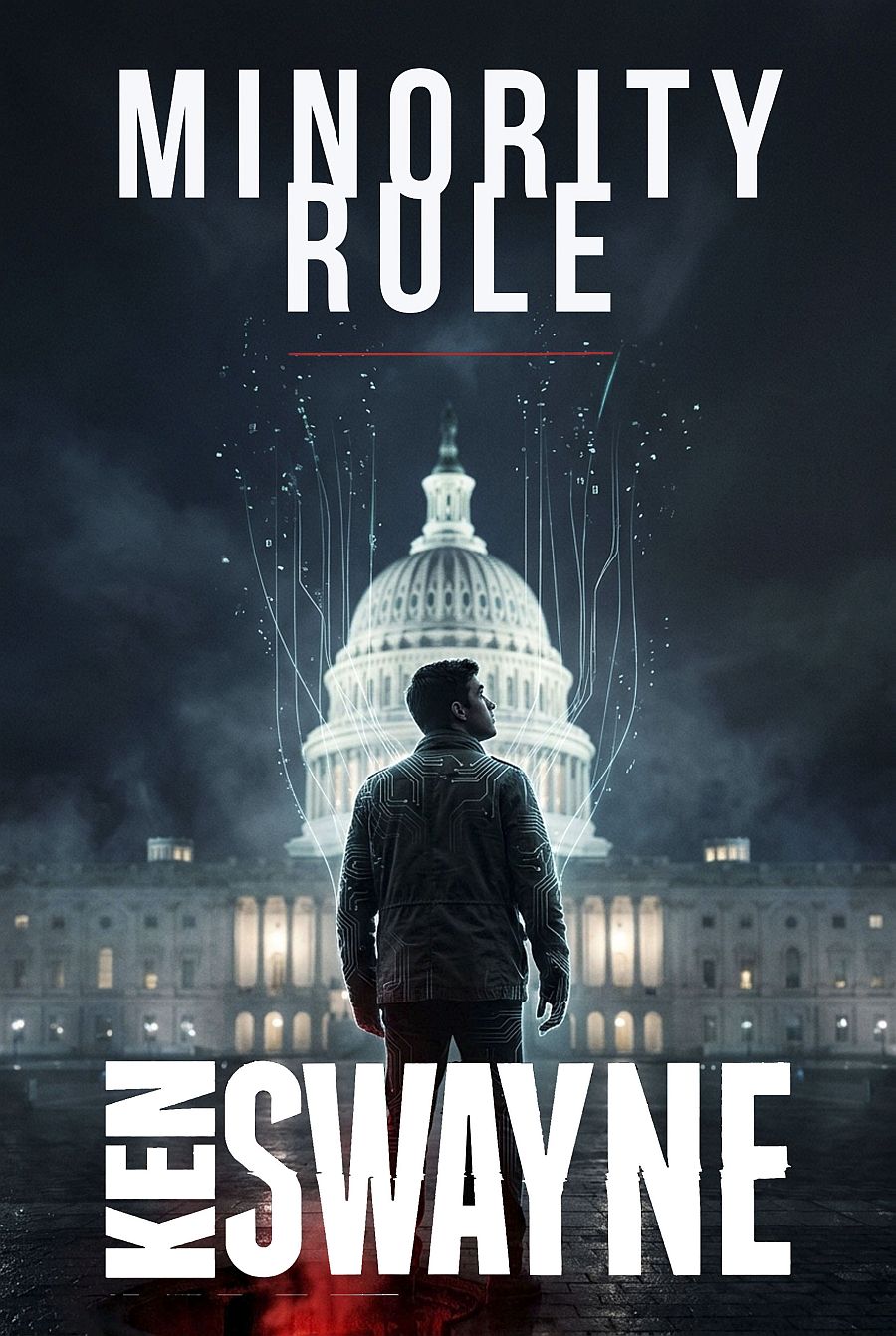
Minority Rule

Standalone Novel · Political Thriller

Minority Rule

The document meant to check that kind of power has a clause in it that was never supposed to be read closely enough to matter.

Not Consolable

Julian Holt was three years into being a name in a platform’s flagged file before he ever knew it existed — a data system built to restore public trust in government, quietly deciding who was worth trusting. By eighteen he was on a ticket. By his twentieth year he was President, sworn in before a Bible held by a stranger, in a room that hadn’t had time to grieve, because the man he’d been chosen to stand beside didn’t live to serve the term either of them had been told to expect.

Evelyn built the systems meant to make government legible. Now she watches one of them make a president invisible, even to himself. The document written to stop exactly this kind of quiet substitution has a clause in Section Nine that nobody was ever meant to read closely enough to find. Some of them have found it anyway.

Evelyn is the only person inside the system who understands exactly what it’s capable of, because she is the one who built the render that makes it invisible to everyone else. What she does with that knowledge — about a boy she watched become a president, and a document with a clause nobody was supposed to find — is the rest of the book.

01Leonardo Codex
02NEXUS
03DISCORD
04Edge Protocol
05Instinct Directive
06Minority Rule
07Unchanged
Buy on Amazon

Why This Novel

The Author’s Context

I’ve spent most of my working life at the front edge of technologies that were still mostly theoretical when I started with them: 3D visualization, virtual reality, augmented reality, each one arriving with the same promise, that we were building better ways to see. What I’ve watched, across five decades of that, is how often the tools built to reveal something end up deciding exactly what gets revealed, to whom, and when.

Minority Rule isn’t a prediction. I don’t think a fifteen-year-old is going to be quietly engineered into the presidency by a data platform, at least not by that name and not on that timeline. But the mechanics in this book — the loopholes, the manufactured trust, the slow substitution of a real person’s judgment for a system’s best guess at it — are not speculative. Versions of every one of them already exist. I wanted to sit with the question of what happens once the substitution finishes: once the system’s best guess at a person gets good enough that the signal and the guess can no longer be told apart, not even by the person standing at the center of it.

Real-World Background

The fiction is built from things that are not fiction.

Political Microtargeting

Campaigns already use granular behavioural and demographic data models to decide which messages a given voter sees, refined continuously as new data comes in.

Continuity-of-Government Protocols

Formal succession and continuity procedures exist precisely because power sometimes has to change hands with no warning at all. The mechanics are real. The transparency around them is not.

Algorithmic Trust Scoring

Reputation and trust-scoring systems, built first for finance and content moderation, are increasingly proposed for use in institutional and political contexts.

The Rulebook vs. the Loophole

Every governing document — a constitution, a charter, a continuity statute — is, like any large text, subject to the gap between what a clause was meant to do and what a sufficiently careful reading allows.

In the Catalogue

Where this novel sits in the argument.

Minority Rule stands outside the Leonardo Codex universe, but pushes the same inheritance mechanism to its furthest point yet — Elena Voss inherits a destiny encoded in her DNA, Seren Pryce inherits a risk classification encoded in her heritage data, Rowan Marchant inherits a career built out of her own research, Julian Holt inherits a presidency out of a flagged file a platform sat on for three years. Not consolable.

The Full Catalogue